Voyager 1 Approaches the One-Light-Day Milestone
Voyager 1 Approaches the One-Light-Day Milestone
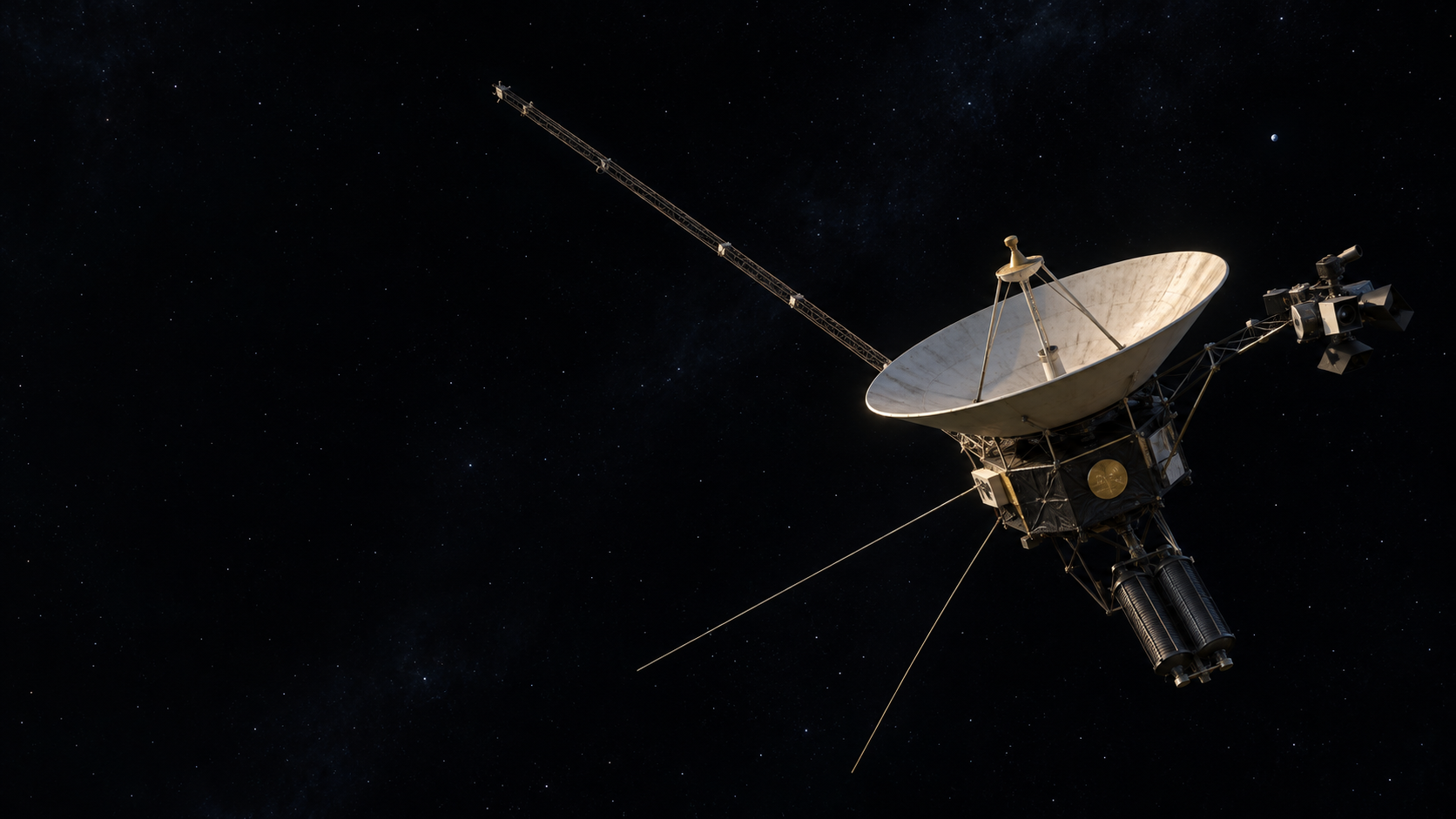
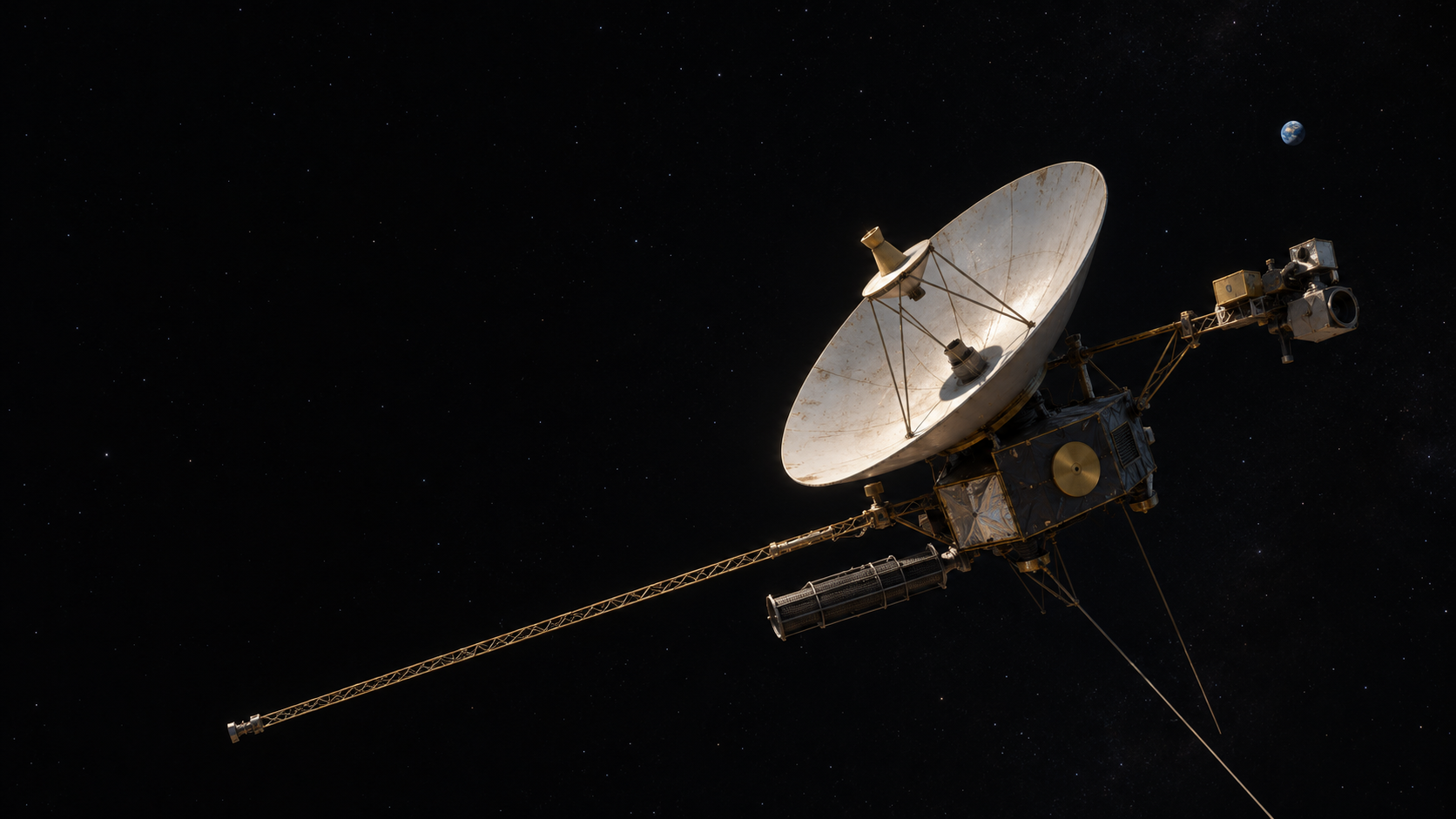
Voyager 1 is the most distant human-made object ever launched. More than four decades after leaving Earth, the spacecraft continues moving through interstellar space and sending faint signals to ground stations.
Its next major distance milestone is approaching: Voyager 1 will eventually be about one light-day from Earth.
A light-day is a distance, not a travel time. It is the distance light travels through a vacuum in 24 hours—approximately 25.9 billion kilometers, or 16.1 billion miles. When Voyager 1 reaches that distance, a radio command from Earth will take about one day to arrive, and a reply will require about another day to return.
The exact date requires careful definition. Earth and Voyager 1 are both moving, and their separation changes continuously. The result depends on whether the measurement is made from Earth’s center, Earth’s surface, or the Sun, and whether the calculation uses a direct Earth-to-spacecraft distance or another trajectory reference. A live mission tracker and a stated calculation method are necessary before publishing a precise date.
The milestone matters even without a single official date. It illustrates the scale of Voyager 1’s journey, the difficulty of communicating with a spacecraft launched in 1977, and the extraordinary durability of a mission exploring an environment no spacecraft had previously reached.
What Does “One Light-Day From Earth” Mean?
Defining a Light-Day
A light-day is the distance light travels through a vacuum in one day. Because light travels at approximately 299,792 kilometers per second, one light-day equals about:
- 25.9 billion kilometers
- 16.1 billion miles
- 173 astronomical units, approximately
An astronomical unit, or AU, is the average distance between Earth and the Sun: about 149.6 million kilometers, or 93 million miles. One light-day is therefore roughly 173 times the Earth–Sun distance.
The term can cause confusion because “day” sounds like a time measurement. In this context, it describes distance using light as the reference. A spacecraft one light-day away is simply far enough from Earth that light needs one day to cross the gap.
Distance and Communication Delay
Radio waves travel at the speed of light. If Voyager 1 is exactly one light-day from Earth, a signal sent from Earth will take roughly 24 hours to reach the spacecraft.
A simplified exchange would involve five steps:
- Mission controllers transmit a command.
- The command travels for about one day.
- Voyager 1 receives and executes the command.
- The spacecraft sends telemetry back.
- The return signal travels for about one more day.
The complete exchange takes approximately two days, excluding onboard processing and operational delays. This is not a real-time control environment. Every instruction must be tested, reviewed, and transmitted with the possibility that confirmation will not arrive until much later.
Voyager 1’s current one-way light time is already measured in many hours. NASA mission pages and Jet Propulsion Laboratory resources provide changing distance and signal-delay figures, so current data should be used instead of an outdated rounded estimate (NASA Voyager 1).
How Far Away Is Voyager 1?
The Most Distant Human-Made Object
Voyager 1 remains farther from Earth than any other human-made spacecraft. It is moving outward on a hyperbolic escape trajectory rather than orbiting the Sun in the same closed path as a planet.
Its distance from the Sun increases continuously, but its exact distance from Earth also reflects Earth’s movement around the Sun. The two measurements are related but not identical.
NASA describes Voyager 1 as the farthest human-made object and reports that it entered interstellar space after crossing the heliopause in 2012 (NASA Voyager 1). Live estimates can also be obtained through NASA and JPL resources, including Eyes on the Solar System.
Voyager 1’s Outward Trajectory
Voyager 1 is traveling generally away from the Sun in the direction of the constellation Ophiuchus. It is not heading toward a nearby star in the ordinary sense and will not arrive at another stellar system on a human timescale.
Its trajectory was shaped by its launch path and gravitational encounters with the outer planets. Voyager 1 flew past Jupiter in 1979 and Saturn in 1980. Its close encounter with Saturn’s moon Titan determined the spacecraft’s subsequent route away from the planetary region.
Voyager 1’s outward speed relative to the Sun is roughly 17 kilometers per second, although the exact value depends on the reference frame. At that speed, it covers several astronomical units each year. Its progress toward one light-day is measurable, but the milestone remains years away rather than days or weeks.
Why the Exact Date Requires Care
A precise one-light-day date can vary according to the definition used. Possible reference points include:
- Earth’s center
- Earth’s surface
- The Sun
- Voyager 1’s instantaneous three-dimensional position
- A rounded distance published by a mission tracker
Because Earth orbits the Sun, the Earth-to-spacecraft distance can differ from Voyager 1’s Sun-centered distance by roughly one AU over the course of a year. A responsible report should identify the reference point, calculation method, and date of the estimate.
Before publication:
- Check NASA or JPL for Voyager 1’s current distance.
- Check the current one-way light time.
- State whether the distance is measured from Earth or the Sun.
- Avoid presenting a rounded estimate as an official NASA milestone date.
- Do not claim that NASA has designated a formal one-light-day date unless an official source says so.
Voyager 1’s Mission
Launch and Original Objectives
Voyager 1 launched on September 5, 1977, from Cape Canaveral, Florida. Voyager 2 launched several weeks earlier, but Voyager 1 followed a faster trajectory to Jupiter and reached the planet first.
The mission was designed to study Jupiter and Saturn. Its launch timing took advantage of a rare planetary alignment that allowed gravity assists to change the spacecraft’s speed and direction while reducing propellant requirements.
The original planetary mission was not expected to last indefinitely. The spacecraft survived its encounters, retained enough power and functionality to continue, and became the first probe to study the outer heliosphere and interstellar space from beyond the heliopause.
Discoveries at Jupiter and Saturn
Voyager 1 transformed scientific knowledge of Jupiter. Its cameras revealed active volcanic eruptions on Io, the first confirmed volcanic activity beyond Earth. The mission also returned detailed observations of Jupiter’s atmosphere, including cloud structures, storms, and complex atmospheric motion.
The spacecraft flew past Saturn in November 1980 and examined the planet’s rings, atmosphere, and magnetic environment. Its encounter with Titan provided important evidence about the moon’s thick, nitrogen-rich atmosphere and placed Voyager 1 on a trajectory that prevented further planetary encounters.
These flybys showed that the outer Solar System was not a collection of cold, inactive worlds. Jupiter’s moons, Saturn’s rings, and Titan’s atmosphere all displayed complex processes that expanded scientists’ understanding of planetary systems.
Beyond the Planets
After its planetary encounters, Voyager 1 continued outward. Its mission shifted from planetary exploration to heliophysics—the study of the Sun, the solar wind, and the heliosphere.
The heliosphere is a vast bubble created by the outward flow of charged particles from the Sun. It moves through the surrounding interstellar medium and forms a changing boundary between the solar wind and interstellar space.
NASA reports that Voyager 1 crossed the heliopause in August 2012, making it the first spacecraft to enter interstellar space. The transition was identified through changes in plasma, particles, and magnetic conditions rather than by crossing a visible wall (NASA Voyager mission).
What Voyager 1 Has Found in Interstellar Space
Voyager 1 measures conditions beyond the heliopause, including particles, plasma waves, and magnetic-field behavior. It does not provide a complete map of interstellar space. Instead, it offers long-duration measurements from a single, exceptionally distant location.
These observations help researchers study how solar particles interact with the surrounding interstellar environment. Voyager 1’s plasma-wave instrument has also helped scientists estimate the density of interstellar plasma by detecting waves moving through the surrounding medium.
The heliopause is not a perfectly fixed spherical shell. Its shape and position respond to solar activity, the solar wind, and the properties of the interstellar medium. Voyager observations have contributed to research on energetic particles, magnetic fields, solar-wind conditions, and the transition between solar and interstellar plasma.
Voyager 1 and Voyager 2 crossed the heliopause at different locations. Comparing their measurements shows that the heliosphere has a complicated and variable structure.
The Pale Blue Dot
On February 14, 1990, Voyager 1 turned its cameras toward the inner Solar System and photographed Earth as a tiny point of light. The image became known as the “Pale Blue Dot.”
The photograph was taken long before Voyager 1 crossed the heliopause and before it approached one light-day from Earth. It is not a current image of the spacecraft’s location. Its importance is philosophical as well as scientific: Earth appeared fragile and small against the darkness of space.
How Voyager 1 Communicates With Earth
The Deep Space Network
NASA communicates with Voyager 1 through the Deep Space Network, a worldwide system of large radio antennas. Its major complexes are in California, Spain, and Australia. Their geographic separation allows NASA to maintain contact as Earth rotates.
The network sends commands, receives telemetry, and supports navigation for missions across the Solar System. Voyager 1’s signal is extremely weak by the time it reaches Earth, so the antennas, receivers, and mission software must work together with great precision (Deep Space Network).
Distance creates several problems:
- Radio signals weaken as they spread.
- One-way communication time increases.
- Antennas must point accurately.
- The spacecraft has limited power.
- Data transmission rates are extremely low by modern standards.
At one light-day, a command sent on Monday could arrive on Tuesday, while confirmation might not reach Earth until Wednesday. Mission teams must plan around that delay rather than react immediately to events.
Aging Hardware and Recent Challenges
Voyager 1 was built with 1970s-era electronics. Its memory, computer systems, heaters, transmitter, and scientific instruments have operated far beyond the original planetary mission.
The spacecraft faces long-term risks, including:
- Declining electrical output
- Aging electronic components
- Reduced heater capacity
- Fewer available instruments
- Memory and data-handling faults
- Increasing difficulty maintaining a clear communications link
NASA has periodically diagnosed and corrected anomalies through commands sent across the growing distance. Specific claims about current faults should be checked against the latest official NASA or JPL update.
Power, Instruments, and Mission Limits
Voyager 1 uses radioisotope thermoelectric generators, or RTGs. These devices convert heat from decaying plutonium-238 into electricity. Their output gradually declines as the radioactive material decays.
NASA has responded by shutting down heaters and scientific systems that are no longer essential. Power management requires difficult choices: keeping one instrument active may reduce energy available for spacecraft heating, communication, or another instrument.
The number of active instruments can change as power and hardware conditions evolve. Current status should be verified through NASA mission updates rather than copied from an outdated summary.
The operational priorities are:
- Preserve command and control.
- Maintain communication with Earth.
- Protect essential spacecraft systems.
- Continue the most valuable scientific observations possible.
Three events must be distinguished:
- The end of a particular instrument’s operation
- The end of scientific data transmission
- The end of all communication with Earth
These events may occur at different times. After the transmitter stops, Voyager 1 will continue coasting through interstellar space under the laws of motion.
Why the One-Light-Day Milestone Matters
A Record of Human Engineering
Reaching one light-day from Earth would mark the continued progress of a spacecraft designed, built, and launched in the 1970s. The mission has required long-term navigation, software maintenance, communications expertise, and careful power management.
Its survival demonstrates how engineering decisions made decades ago can support scientific work far beyond the original mission plan.
A New Perspective on Interstellar Distance
One light-day is enormous by human standards but modest compared with stellar distances. The nearest star system, Alpha Centauri, is more than four light-years away. One light-year equals approximately 365 light-days.
Voyager 1 is therefore nowhere near another star. Even after reaching one light-day from Earth, it will have covered only a small fraction of a light-year. Leaving the heliosphere is not the same as arriving at another solar system.
Lessons for Future Missions
Voyager’s longevity provides practical lessons for future deep-space spacecraft. Designers must account for declining power, slow communication, radiation exposure, limited computing resources, and the need to diagnose problems from billions of kilometers away.
Future interstellar probes may use more advanced electronics and power systems, but they will face the same fundamental challenge: distance turns ordinary engineering problems into long, carefully planned operations.
Common Misunderstandings
“Voyager 1 Is One Light-Year Away”
It is not. A light-year is approximately 365 light-days. Voyager 1 is approaching one light-day from Earth, only a small fraction of one light-year.
“Voyager 1 Will Reach Another Star Soon”
It will not. Voyager 1 is traveling through interstellar space, but the distance between stars is vast. Its trajectory does not bring it close to another star on a human timescale.
“One Light-Day Means Voyager Took One Day to Get There”
The phrase describes the time light needs to cross the distance. Voyager 1 took decades to travel outward and will continue moving for millions of years.
“Voyager 1 Is Completely Outside the Solar System”
The answer depends on the definition of “Solar System.” Voyager 1 crossed the heliopause and is in interstellar space, but it remains within the Sun’s broader gravitational influence. Interstellar space does not automatically mean the spacecraft has escaped every aspect of the Solar System.
How to Verify the Milestone
Distance figures should be updated immediately before publication. Check NASA’s Voyager mission pages, JPL resources, the Deep Space Network, Eyes on the Solar System, and current mission-status updates.
Record the date and time of the measurement. State whether the figure represents distance from Earth or the Sun, and identify whether it is a live estimate or a calculated projection. Do not rely on unrelated or unverifiable sources for claims about Voyager 1’s distance, instruments, or mission status.
Conclusion
Voyager 1 is approaching a distance at which light itself will need about one day to travel between the spacecraft and Earth. The milestone will make communication slower, weaker, and more demanding, while providing a vivid measure of how far a human-made machine has traveled.
The spacecraft has transformed knowledge of Jupiter, Saturn, Titan, the heliosphere, and interstellar space. It has survived for decades on declining radioisotope power and technology designed before the modern internet existed.
Eventually, Voyager 1 will stop returning scientific data and then stop communicating altogether. Its motion will continue. Long after its transmitter falls silent, the spacecraft will keep crossing the Galaxy as a durable artifact of Earth’s first steps into interstellar space.
FAQ
How far away is Voyager 1 from Earth?
The distance changes continuously because Voyager 1 is moving outward and Earth is orbiting the Sun. Use NASA or JPL’s current mission tracker and confirm whether the displayed distance is measured from Earth or the Sun.
When will Voyager 1 be one light-day from Earth?
The date depends on the reference point and calculation method. A reliable estimate requires current spacecraft data, its outward velocity, and a clearly defined Earth-to-spacecraft distance. Avoid presenting a precise date without identifying the source and method.
How long does a signal take to reach Voyager 1?
The one-way signal time equals the distance expressed as light-travel time. At one light-day, a radio signal takes approximately 24 hours to arrive. A command-and-response exchange takes approximately two days, excluding processing and operational delays.
Is Voyager 1 outside the Solar System?
Voyager 1 crossed the heliopause in 2012 and is operating in interstellar space. However, it remains within the Sun’s broader gravitational domain, so “outside the Solar System” requires a specific definition.
Is Voyager 1 still sending data?
Mission status can change as power declines and equipment ages. Check NASA’s latest Voyager updates before making a current claim. Communication is increasingly difficult because of weak signals, long delays, limited power, and aging hardware.
How long will Voyager 1 continue traveling?
Voyager 1 will continue coasting through space after its instruments and transmitter stop working. Scientific operations and communication will end before the spacecraft’s physical journey does. The probe will continue through the Galaxy for millions of years.
Related Articles
-
 Eagles Preying on Human-Sized Baboons: What It Means
-
 Leonid Meteor Shower 2026: Peak Date and Viewing Guide
-
 DESI Estimates the Milky Way’s Mass at 1.19 Trillion Suns
-
 Deep-Sea Mining Rocks Also Provide Habitat for Tiny Creatures
-
 Rare Black Holes Born Without a Supernova
-
 125,000-Year-Old Poisoned Stone Points in Arabia?
-
 How Animals Survive Being Frozen Solid
-
 Why People Are Flashing Lights for Voyager 1
-
 Leonid Meteor Shower 2026: Peak Time and Viewing Guide
-
 Northern Lights Forecast: 12 States May See Aurora
-
 NASA Investigates Mars’ Mysterious “Potato Chip” Shapes
-
 Voyager 1 Reaches the One-Light-Day Milestone
-
 Voyager Probe Nears One Light-Day From Earth
-
 Thinkers of Cernavodă: Stone Age Figurines
-
 Why NASA Wants You to Shine a Light for Voyager 1
-
 Stephen Hawking’s Private Life Reexamined