What the Crimean Bridge Attack Means for Russia
What the Crimean Bridge Attack Means for Russia
Introduction
The Crimean Bridge is more than a road and rail connection. It links Russia’s mainland with Crimea, supports civilian movement and supply deliveries, and represents Moscow’s claim that Crimea is permanently integrated into Russia. An attack therefore carries consequences beyond damaged concrete or interrupted traffic.
Ukraine’s Security Service said a section of the road was destroyed and that vehicles could not cross. A Russian official separately confirmed that the bridge had been attacked again. Reports differ over the method, the extent of the damage, and the repair timetable. The available material does not provide a complete independent engineering assessment.
The central issue is what the incident reveals about Russia’s military vulnerability, the protection of critical infrastructure, and the Kremlin’s ability to project control. It also tests Russia’s logistics in Crimea, its public messaging, and its ability to prevent repeated attacks against a highly visible national symbol.
What Happened?
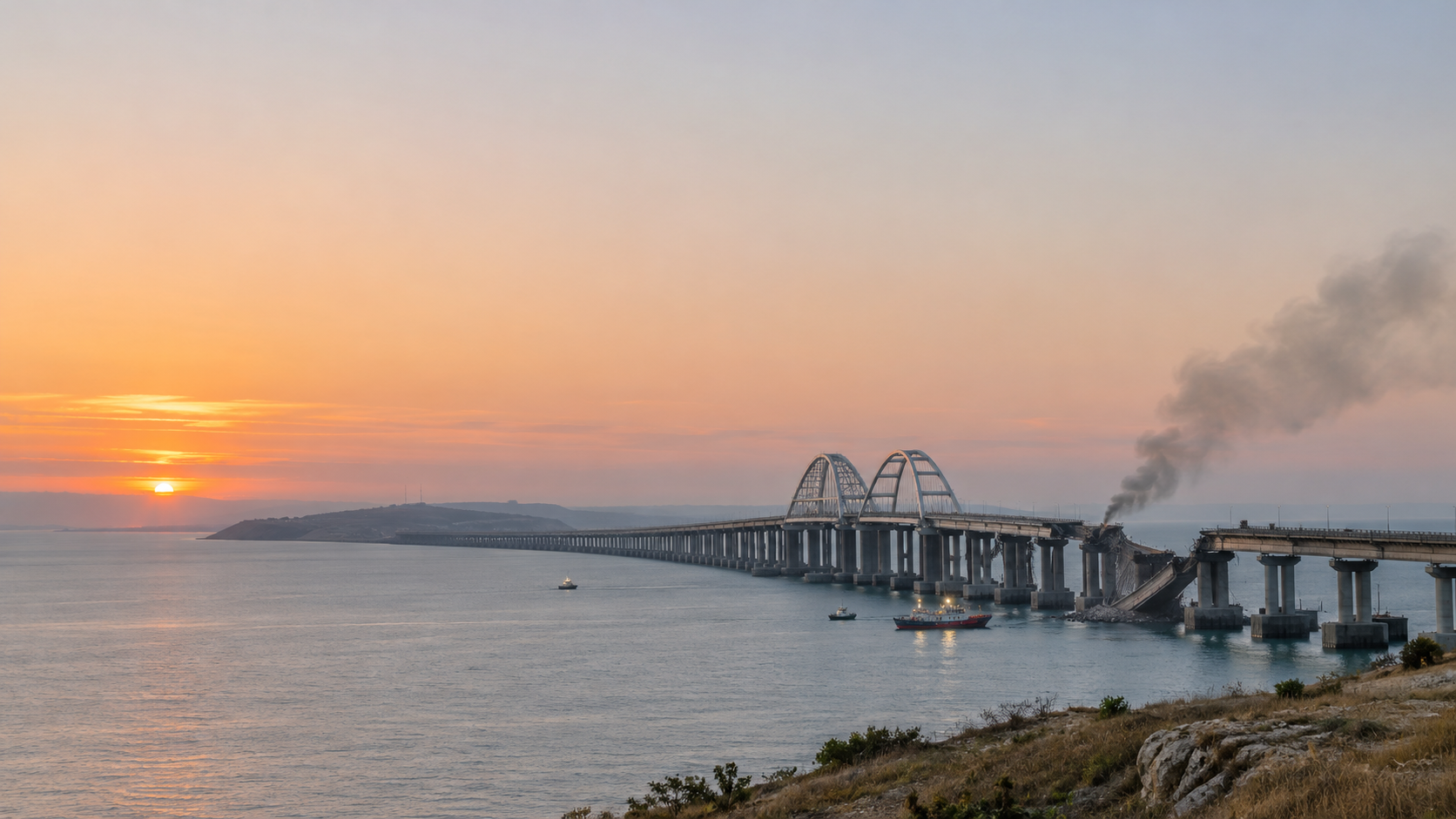
Ukraine’s Security Service reported that a road section of the Crimean Bridge had been destroyed, preventing vehicles from crossing Source 3. A Russian official separately confirmed that the bridge had been attacked again Source 5.
These accounts establish that an attack occurred and that road traffic was affected. They do not independently establish the precise method, the bridge’s full structural condition, or the duration of the closure. Reports that part of the bridge collapsed into the sea, including coverage by JAMnews, should therefore be treated as reported accounts rather than complete technical assessments Source 9.
A road closure can cause delays, diversions, additional inspections, higher freight costs, and disruption to tourism and emergency services. The bridge is a bottleneck: alternative routes may remain available but offer less capacity, speed, or convenience.
Road and rail traffic must be assessed separately. Damage to a road section does not automatically establish damage to railway infrastructure or prove that military supply movements have been cut. Satellite imagery, engineering inspections, transport notices, and repair data are needed to assess the operational effect.
Strategic Importance
The bridge supports civilian transport, fuel deliveries, food shipments, construction materials, government activity, and emergency services. It is not the only route into Crimea, and a temporary closure does not automatically isolate the peninsula. Its importance depends on the duration of the disruption, the availability of alternative corridors, and the traffic those corridors can absorb.
The bridge may also support Russia’s broader military infrastructure in southern Ukraine. A disruption could reduce flexibility in moving equipment, personnel, fuel, and other supplies while increasing dependence on land, rail, maritime, or stockpiled alternatives. The immediate impact would likely be tactical: rerouted traffic, delayed movement, and revised supply plans. A prolonged closure could create wider operational pressure.
The attack also raises questions about Russia’s ability to protect a long and exposed structure. Authorities may review air-defense deployments, surveillance, maritime patrols, inspections, access controls, and intelligence-sharing procedures. Continuous protection requires resources that may also be needed elsewhere on the battlefield.
Political Meaning for the Kremlin
The bridge is a prominent symbol of Russia’s claim over Crimea. Its construction and operation have been presented as evidence of state investment, territorial permanence, and Moscow’s ability to connect and protect its claimed territory.
An attack challenges narratives of territorial control, domestic security, military competence, and civilian protection. DW examined the incident’s wider political and security implications for Russia Source 1.
The incident does not prove an immediate political crisis. Russia retains extensive state capacity and can present repairs, security deployments, and alternative transport arrangements as evidence of control. However, the symbolic damage could exceed the physical damage if the public begins to view the bridge as vulnerable.
Russian authorities must explain closures and safety measures without exposing security failures. Delayed or inconsistent statements can encourage speculation. A brief closure followed by credible restoration may limit the political effect, while repeated incidents or extended restrictions could deepen public doubts.
Military Bloggers and Domestic Criticism
Russian military bloggers influence the pro-war information environment. Their audiences include soldiers, veterans, nationalist supporters, and politically engaged civilians. The Kyiv Independent reported that bloggers reacted angrily to the attack, focusing on the bridge’s vulnerability and the authorities’ handling of the incident Source 7.
Their criticism does not represent every Russian citizen or establish a unified military position. It does show that support for the war can coexist with criticism of wartime administration. Their reactions may reflect frustration with defensive failures, demands for retaliation, concerns about operational security, or suspicion that official statements understate the problem.
The Kremlin may tolerate criticism of individual failures while resisting narratives that directly question state authority or the wider war strategy. If attacks continue, bloggers may increase pressure for visible security reforms and retaliation.
Civilian and Economic Effects
The immediate effects may include longer travel times, disrupted tourism, higher freight costs, and more complex emergency responses. Fuel and food deliveries could face delays if alternative routes cannot absorb traffic efficiently.
The economic impact depends on the length of the closure. Short interruptions may cause inconvenience without major shortages. Extended restrictions could increase prices, complicate business planning, and weaken tourism. Additional checkpoints, inspections, and surveillance could improve security while making ordinary movement more difficult and further militarizing civilian space.
Possible Russian Responses
Russia may expand patrols, strengthen air-defense coverage, increase drone and maritime monitoring, tighten access controls, and inspect nearby infrastructure. These are plausible responses, not confirmed outcomes.
Other possible measures include strikes against Ukrainian infrastructure, public threats, new restrictions in Crimea, claims of foreign involvement, and intensified information operations. A declared response does not automatically represent a change in military strategy; its significance should be judged by actual operations, force deployments, and sustained policy changes.
Rapid restoration would allow Russia to reopen civilian traffic, reassure residents, demonstrate state capacity, and reduce the attack’s symbolic impact. Reopening too soon, however, could create safety risks if structural assessments are incomplete. Official timelines should be compared with independent engineering analysis, satellite imagery, and traffic data.
What the Attack Does Not Prove
The attack does not by itself prove that Russia has lost control of Crimea, that Crimea’s supply network has collapsed, or that the bridge is permanently unusable. It does not establish that Ukraine can sustain attacks at the same scale or that Russian public support has fundamentally changed.
Analysis should separate tactical success, strategic effect, political symbolism, and long-term military consequences. A damaged bridge may cause a major symbolic setback but limited operational disruption. Repeated interruptions could become strategically important even if each incident is temporary.
Scenarios to Watch
Limited and Temporary Disruption
The bridge could reopen after repairs. Russia would likely increase security and present the incident as contained. Military logistics could shift temporarily to alternative routes.
Repeated Attacks and Extended Closures
Further attacks could disrupt civilian and military traffic, force Russia to dedicate more resources to protection, and intensify criticism from military bloggers and regional officials.
Escalation Beyond the Bridge
Russia could use the attack to justify broader strikes, restrictions, or information operations. The incident could become part of a cycle of retaliation affecting civilian infrastructure and regional stability.
Conclusion
The Crimean Bridge remains a critical transport link, a potential military logistics route, and a powerful symbol of Russia’s claim over Crimea. The attack exposes vulnerabilities in infrastructure protection and challenges the Kremlin’s image of control.
The reported anger among Russian military bloggers indicates internal pressure over security failures and official handling. It does not amount to a political crisis, but it shows why the bridge matters beyond its physical function.
The attack is not automatically a decisive military turning point. Its significance will depend on the duration of the damage, the speed and safety of repairs, the possibility of future attacks, Russia’s response, and the ability to maintain civilian and military movement.
FAQ
What is the Crimean Bridge?
It is a major road and rail connection linking Russia’s mainland with Crimea. It supports civilian travel, economic activity, supply movement, and government administration, while also carrying military and symbolic significance.
What happened in the latest attack?
Ukraine’s Security Service reported that a road section was destroyed and that vehicles could not cross Source 3. A Russian official confirmed that the bridge had been attacked again Source 5. The supplied sources do not provide a complete independent assessment of the damage, cause, or repair timeline.
Why is the bridge strategically important?
It connects Crimea with Russia’s mainland, supports civilian transport and potentially military logistics, and serves as a major symbol of Russia’s claim over Crimea.
Does the attack mean Russia has lost control of Crimea?
No. It demonstrates vulnerability and disruption, not automatic loss of territorial control. Its wider significance depends on the closure’s duration, alternative routes, and further attacks.
How might Russia respond?
Possible responses include tighter security, expanded surveillance, rapid repairs, public blame, new restrictions, and military retaliation. Specific measures require confirmation from reliable reporting.
Why did Russian military bloggers react angrily?
The Kyiv Independent reported that they focused on the bridge’s vulnerability and the authorities’ handling of the incident Source 7. Their reactions may reflect frustration with security failures, demands for retaliation, and concern that officials understated the problem.
Related Articles
-
 Trump, Xi and Putin: APEC Meeting Explained
-
 Iran Warns Bahrain Over U.S. Fifth Fleet Presence
-
 Israeli Tanks Reportedly Cross Gaza’s Yellow Line
-
 Why Trump, Xi and Putin’s Summit Won’t Be Yalta 2.0
-
 Rwanda Migrant Hub Plan Faces Human Rights Backlash
-
 Iran War Updates: Gulf and Tanker Risks Unverified
-
 Israeli Gaza Operation Beyond Yellow Line: What We Know
-
 Florida Coast Could See 18 Inches of Rain by Friday
-
 US Intelligence Chief Rejects State-Sponsored Attack Theory
-
 Cornyn Blocks Trump Texas Judicial Nominee
-
 Hakeem Jeffries Nominated for House Speaker
-
 Trump’s Shenzhen Arrival and Xi’s Family History
-
 Ukraine Reportedly Struck Crimean Bridge Without Starlink
-
 Iran-Kuwait Air Base Attack: What We Know
-
 Putin’s Asia Visit Highlighted by Russian Tu-95 Bombers
-
 Democrats Nominate Hakeem Jeffries for House Speaker